

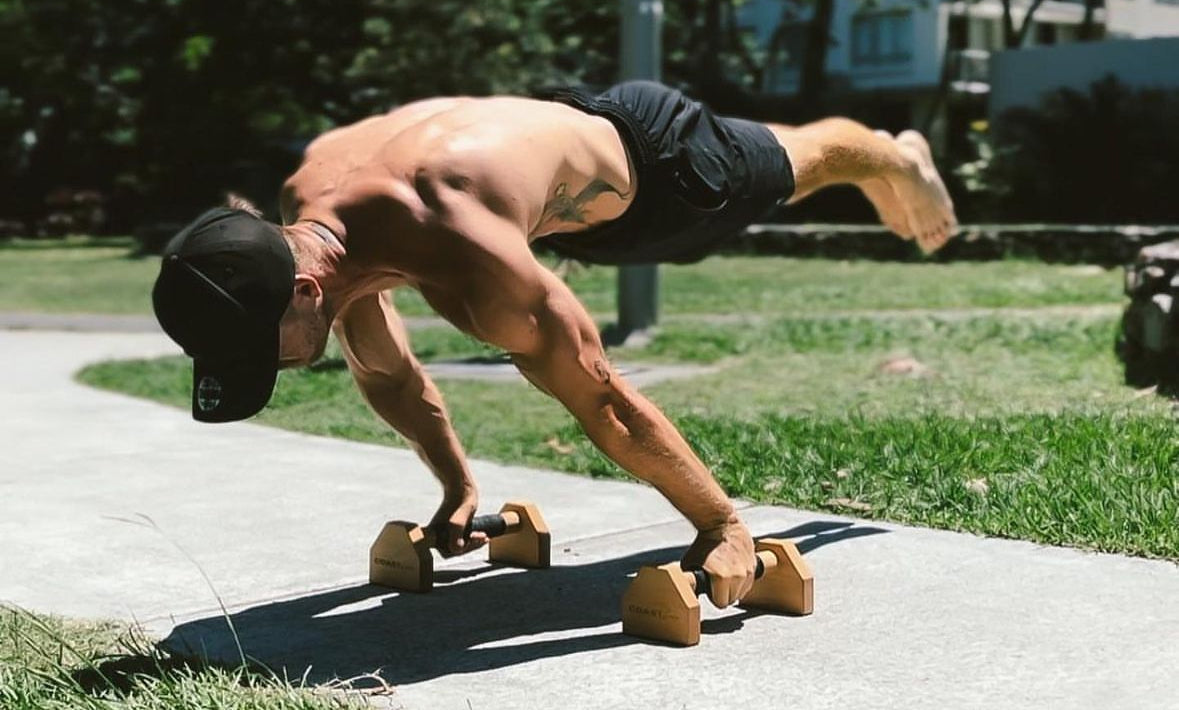
Just bought your first parallettes, or about to? The most common question we get is simple: what height should a beginner use? The short answer is that it depends on what you want to train. This guide explains why in plain English, so you can pick the right pair the first time.

The quick answer
- Mostly push-ups, planche or handstands? Start with low parallettes. They feel stable and you're never far from the floor.
- Mostly L-sits, deficit exercises and leg raises? Go taller. Your legs need room to clear the floor.
- Many people end up with one low pair and one tall pair.
Why height changes everything (the simple science)
1. Your legs need somewhere to go
In an L-sit, your hands push you up and your legs stick straight out in front. If the bars are low, your heels hit the floor before your hips can lift. Taller bars give your legs that clearance. The longer your legs, the more height you need. That's why taller people often find low bars cramped for L-sits and dips.
2. Lower means calmer for balance
When you're learning a handstand or planche lean, your body is constantly making tiny corrections. Being close to the ground makes falling out feel less scary, so you relax and practise more. Low bars are the beginner-friendly choice for anything balance-based.
3. Gripping a bar is kinder to your wrists
Doing push-ups or handstands with flat palms on the floor bends your wrists back a long way. Gripping a parallette lets your wrists stay straighter (what coaches call a "neutral" position), which is why many people with sore wrists find parallettes more comfortable. This works at any height, so even a low pair helps.

4. More height means more range
On taller bars, your chest can travel lower than your hands in a push-up. That extra range of motion makes each rep work your chest and shoulders harder. It's a great progression once standard push-ups feel easy.
Low vs tall: what each is best for
| Exercise | Low parallettes | Tall parallettes |
|---|---|---|
| Push-ups | Great | Great, with deeper range |
| Handstand balance | Best | Once you're confident |
| Planche leans and tuck planche | Best | Good |
| Tuck holds | Good | Good |
| Full L-sit and V-sit | Hard if you're tall | Best |
| Dips | Not possible | Best |
| Handstand push-ups | Small range | Full, deep range |
Don't forget length
Height gets all the attention, but the length of the bar matters too. A longer bar gives your hands more room to move and spreads your weight over a wider base, so it feels more stable. Our Classic Parallettes come in 30cm and 50cm lengths. The 50cm is a great pick for bigger hands or if you want extra stability while you learn.
4 beginner mistakes to avoid
- Going tall for balance work too soon. Build confidence close to the floor first.
- Buying wobbly bars. If a bar shifts under you, you won't trust it. Stability beats a cheaper price every time.
- Ignoring grip. Sweaty hands slip. Wraps or chalk make a big difference.
- Skipping a wrist warm-up. Two minutes of wrist circles and gentle stretches before each session goes a long way.
Our picks for beginners
Just starting out: Classic Parallettes

Premium beechwood with a non-slip rubber base, and rated 4.9 out of 5 by our customers. As one buyer put it: "Better than expected, great quality... Highly recommend to anyone starting or already doing calisthenics." Want everything in one go? The Cali Starter Pack adds resistance bands and liquid chalk.
Want room to grow: the Parallette Pack

Can't decide between low and tall? Get both. This bundle pairs our tall Premium Parallettes (steel frame, beechwood handles) for L-sits, dips and deep push-ups with our Classic 50cm for balance work. It costs less than buying them separately, and you won't outgrow it.
Handstand focus: the Balance Bundle

Our Classic 50cm Parallettes plus a pair of Handstand Blocks. The blocks sit right down near the floor, making them ideal for wrist-friendly balance practice, while the parallettes cover your L-sits and push-ups.
Train anywhere: Travel-ettes

Low, compact and just over 1kg. They strap together and fit in your gym bag, so you never miss a session. Want a full portable kit? Check out the Traveller pack.
Finish your setup
Add Parallette Wraps for a sweat-proof grip, or grab the Grip Kit with grip tape, wraps and liquid chalk.
Frequently asked questions
What height parallettes should a beginner get?
Low parallettes if you mainly want push-ups, planche or handstands. Taller parallettes if you mainly want L-sits or if you're tall. If you're unsure, a taller pair is the more versatile choice.
Are taller parallettes harder to use?
For balance skills, slightly, because being higher off the ground can feel less secure. For L-sits and dips, taller bars actually make things easier, because your legs have room to move.
What parallettes are best for L-sits?
Taller parallettes, especially if you're tall. You can still learn tuck L-sits on low bars and move up later.
Are parallettes good for sore wrists?
Many people find them more comfortable than the floor. Gripping a bar keeps your wrists straighter than pressing on flat palms. If you have an injury, check with a physio first.
Do I need more than one pair?
Not to start. But lots of people add a second pair later so they have a low bar for balance and a tall bar for strength. Bundles like the Parallette Pack make that cheaper.
The bottom line
Choose your height based on what you'll train most over the next few months. Low for balance and push-ups, tall for L-sits and dips, or one of each if you want it all. New to calisthenics? Read our guides on how to start calisthenics at home and what equipment you actually need.
Ready to start? Shop all parallettes. Australian owned, fast shipping from Sydney, and free shipping on orders over $150.